
Hero Siege Build Planner - What to Plan Before You Respec
What a Hero Siege build planner should track: skill trees, Incarnation stats, gear requirements and variants for leveling, clearing and bossing.
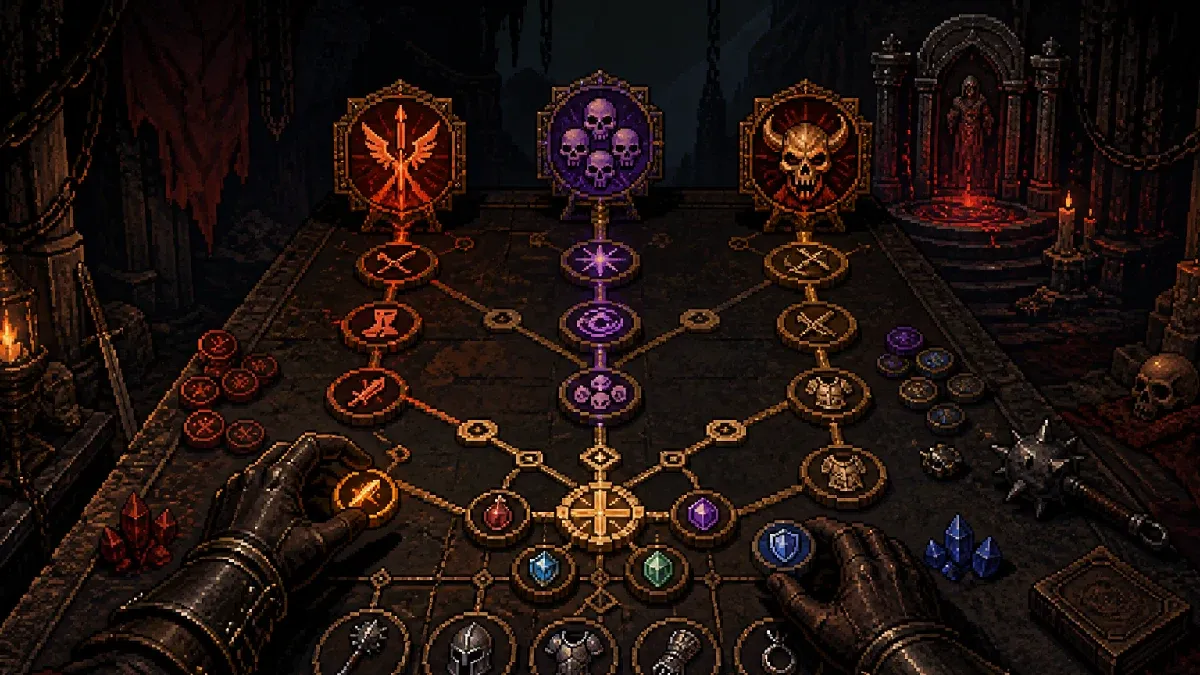
The argument for planning a Hero Siege build outside the game is simple: respeccing costs you something and planning does not. With dozens of talents and specialisations per class, the cost of finding out a setup does not work is paid in resources rather than only time.
What should a Hero Siege build planner cover?
A useful planner needs four connected layers:
- Skill trees — the active skills, passives and specialisations chosen for the class.
- Incarnation stat investment — the prestige-system grid that drives late-game power.
- Gear — item slots and rarities, so you can see what the setup needs before you own all of it.
- Build variants — separate early-game, clearing and bossing versions of the same character, with a route between them.
That last layer matters most. Because clearing and bossing ask for different setups, a planner that stores only one configuration per character misses the decision you most need to make.
Why share a build as a link?
A permanent link gives a player one exact snapshot to discuss in Discord, a guild chat or a stream. It lets everyone see the same points and gear instead of trying to reconstruct a setup from a paragraph.
The corollary is worth stating: a shared link is a snapshot. It records what worked when it was made, not what works now. Season and patch changes can reorder archetypes, so check the date and game version before copying it point for point.
Should you plan before or after picking a class?
After. Damage type constrains everything downstream — melee classes want different weapon scaling from spell classes, and gear saved for one route may do little for the other. Choose the damage type, then the class, then the job, and only then plan the point-by-point setup.
What will our detailed build pages show later?
The first detailed build page will stay static and evidence-led. Its layout is planned around the decisions a player needs to reproduce a setup:
- Build overview — class, season, job, damage type and gear threshold.
- Skill route — the selected tree, priority and respec points.
- Attributes and Incarnation — what to invest in and why.
- Gear by slot — requirements, alternatives and upgrade order.
- Variants — leveling, clearing and bossing differences.
- Patch notes — what was checked and what may have changed.
That gives us the useful depth of a community planner without pretending the site already has a complete, live in-game database.
A caveat on planner accuracy
Planners are community tools, not official ones. They can lag a patch, and a skill or node may have been renamed or rebalanced in-game. Use a planner to think through a build, then confirm the final skill names against the current in-game tree before spending points.
What should you do next?
Open the Season 10 class atlas, shortlist a class, and decide whether you need a leveling, clearing, bossing or endgame-pushing route before collecting the point-by-point setup.
Related Articles
builds
Hero Siege Builds - Season 10 Class Atlas
Browse all 24 Hero Siege classes, find Season 10 class guides, and learn how skills, Incarnation stats and gear fit into a complete build.
guides
Incarnation Tree Guide - Hero Level Tree Replacement
The Incarnation Tree replaced the Hero Level Tree in Season 9 as Hero Siege prestige progression. What it does, where it sits, and how to plan investment.
Was this helpful?
Thanks for the feedback!